
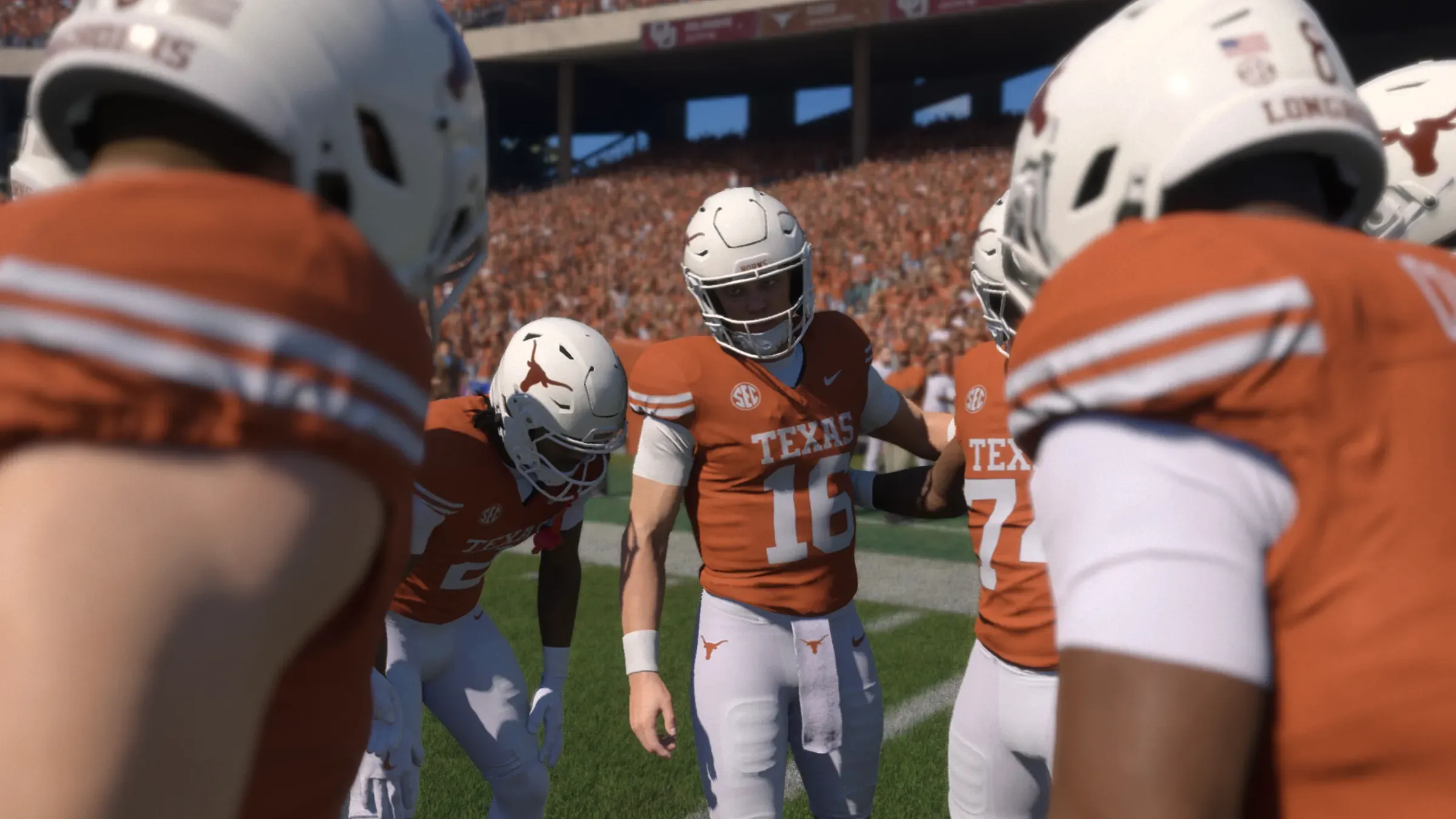

Anyone who’s played College Football over the years knows that Dynasty Mode has always been the living, breathing soul of the franchise. Yes, Road to Glory lets you take a personal journey to fame and fortune. Ultimate Team gives you a nice live-service model to play with — and possibly exploit. And there’s always online play if you want to just get together with your buddies and battle it out on the field.
But the fantasy of managing a college football team — which is arguably the crux of a simulator aimed at recreating the real-life experience in a digestible, digital format — has always been Dynasty Mode. It’s the home of college football, and we’re quite eager to get started with it in College Football 27. That’s because EA seems to have gone beyond merely recruiting players to play games and then simulating seasons.
Things are different this time around. The latest iteration of Dynasty Mode, after two years of tweaks and modifications, looks like it’s the real deal — with the entire experience coming close to managing an entire program. That includes managing expectations, dealing with spreading limited resources across the board, staffing challenges, negotiating NIL deals, facing the pressures a coach would face, trying to retain players who would rather take their talents elsewhere, and establishing a team’s long-term identity one step at a time.
That’s a long list of things to do — but that’s precisely why we think this year’s iteration of Dynasty Mode might be the real main event. Join us as we take you through what’s made us so optimistic about it.

The Third Time’s the Charm
If CF 25 was the comeback after a very long hiatus for the franchise, CF 26 was a title that brought in a lot of refinements that proved quite popular. Based on that trajectory and everything we’ve seen of CF 27 so far, it’s certainly looking like a big swing from EA — going past incremental improvements to present a bold, confident take on the sports sim that could easily find fame and glory thanks to what it’s bringing to the table.
EA is positioning College Football 27 as the third step in its rebuilt Dynasty roadmap, following the comeback foundation of *25* and the refinements of *26*. And from what we’re seeing, it isn’t just about adding new features and calling it a day. That would be too easy — and a potentially lazy solution to the vision it has presented. Its latest deep dive into Dynasty Mode showcases how it’s clearly being pitched as a deeper program-management experience rather than just another recruiting-and-season sim loop.
Instead, we’re looking at a program management mode that feels akin to what it would be like to manage an evolving landscape of players with many variables for us to control. Or at least, try as life attempts to wrest that very control out of our hands in a take on franchise management that’s bringing all of the chaos from the real world to our screens.
Where Road to Glory is about a single player, Ultimate Team puts you on a hamster wheel where you’re collecting players and grinding out levels, and Road to CFP is about simulating the competition — Dynasty brings all of that into one place, putting you right at the center of the broader fantasy of a college football simulator. It isn’t about a single season, but about building a lasting legacy within the framework of the game.
Athletic Director Expectations – The New Pressure Point
Athletic Director Expectations are the clearest example of that shift. Instead of treating every job like the same climb with different uniforms, CF 27 gives each program its own pressure points, patience level, and definition of success. A powerhouse could expect you to put them front and center of playoff runs — and perhaps not take too kindly to a decision to hold them back. A school that’s still trying to make a name for itself might give you a bit of breathing room as you try to help it get on the map. One job might hinge on rivalry wins, another on owning a recruiting pipeline, another on building an offensive or defensive identity, and another on keeping facilities or rankings at a required standard.
All of these parameters become part of an ever-changing landscape that you’re then expected to manage — just as a talented coach would have to do in the real world. A solid record may buy patience at one school and still feel like underachievement at another, depending on what the program believes it should be competing for. The new Dynasty isn’t just about winning — but doing so in a way that serves your school’s interests and expectations.
Of course, that can get chaotic without the game’s systems giving you a bit of control over the chaos. That’s where Dynasty Blueprint comes in, turning those expectations into an annual resource puzzle rather than just a list of objectives. You could choose to allocate a significant amount of funds to secure NIL rights for a recruit, or perhaps use that money to create facilities that secure your team’s long-term growth. You could also invest in staff to better support your team — or perhaps spend it all on ensuring a win-now season if that’s what your school really wants. Because Dynasty Points operate as a yearly, use-it-or-lose-it budget, the mode pushes you to make short-term calls instead of hoarding resources forever.
It’s about handling pressure — and handling it well enough to cement your own position within growing teams. And that’s just scratching the surface on systems that go a lot deeper.

A More Hands-On Approach – NIL and Retention
There’s a reason we mentioned NIL when talking about using your Dynasty Points as effectively as you can. In the real world, it’s a factor that gives players a fair bit of control over the trajectories of their football careers. CF 27 is making that a factor of the experience by ensuring that the onus of retaining them — or letting them move on to greener pastures — is on you. Recruiting was already a major part of the experience in previous titles, and making retention become a factor makes things all the more authentic.
Given that you only have a limited number of Dynasty Points to reflect your budgets, you’re going to be smarter with resources in smaller programs while having to manage high expectations on powerhouse programs. It makes retaining your best players as important as recruiting new ones — and it’s a great way to link factors like prestige, deal breakers, and school strength in a way that’s both comprehensive and cohesive. The new approach to NIL makes Dynasty less predictable, which is something the mode has needed.
Factor in facilities and staff, and the NIL system’s unpredictability gets amplified, its scope extending beyond your team’s potential on the field. Once again, it’s a showcase of how the entire management experience is more all-encompassing this time around — as your facilities and staff become long-term investments that can shape your program’s identity while making coordinators matter a whole lot more. Program grades then become a part of the long-term loop, making rebuilds feel different from merely stepping in to take over a well-established program.
The Coaching Carousel and Storytelling
Those differences are a welcome addition, and a fine way to ensure that the coaching carousel actually has an impact on how things go for you and your team. You’re not just grinding out levels — which was something we couldn’t help but notice in previous iterations — but building a resume that gives you as much negotiating power as your powerhouse programs. It’s an effective way of making successes or failures work both ways between players and a coach, tying job openings to school expectations in a way that gives you a lot of choices, but with enough tradeoffs to make those decisions feel as agonizing as they might be in the real world.
Of course, all of that feeds very well into the new Dynasty storytelling engine, which brings in dynamic weekly recaps, Heisman Watch updates alongside a fully animated ceremony, and so much more. They’re all great ways to give a season context and flavor while making you feel like your decisions and hard work actually matter — being as impactful to your team’s journey as they can be. If everything else we’ve talked about lets you manage numbers to achieve the best possible advantage, this is where the drama comes in — presenting it all in a way that gets you immersed in the spectacle and realism of it all.
It’s all shaping up to look like this could be the most personal take on College Football‘s Dynasty Mode. And the Team Builder now bringing in customizable elements like unique backgrounds and signature accents is a great touch. It lets you imagine yourself in the thick of the action at a stadium, your personal attachment to a program you’ve built represented well in the atmosphere around the games you’re a part of.

Building Balance – The Risk of Ambition
You’re probably wondering if everything we’ve said so far makes things look like they’re too good to be true. Believe us when we tell you that the thought has crossed our mind. Ambitious changes like the ones we’ve been talking about come with a lot of risk. The new NIL systems could become an unending maelstrom that sucks in your limited budget, leaving you at the mercy of a treacherous sea of unpredictability.
The Athletic Director systems could be seen as too random, running the risk of generating expectations that seem unfair due to how unrealistic they are perceived to be. The logic between the Coaching Carousel and recruitment and retention must land as perfectly as it can in order for it to be believable — holding up across multiple seasons in a way that makes sense to us all. There needs to be a balance — and it has to be one that holds up under the duress of multiple concurrent seasons for the entire simulation to work.
All of these are reasons to be wary of getting too invested in what’s coming before we get to try it out. But they’re also a great showcase of how EA hasn’t just added new things to Dynasty and called it a day. It’s evolving what the mode is supposed to be in the modern era of college football. If it manages to get things right, it could make Dynasty go from being just another mode to indulge yourself in — and become the one that defines the entire game.
College Football 27 is shaping up to be a defining moment for the franchise — and Dynasty Mode is finally getting the attention it deserves. Whether it lives up to the ambition remains to be seen, but for the first time in years, it feels like EA is actually listening to what fans have been asking for.
Now we just have to wait and see if they can pull it off.
Related posts:
 007 First Light Is Making the Case for Shorter, Sharper AAA Campaigns – And It’s About Time
 The Next Ghost Recon Has Become One Big Question Mark – And That’s Being Generous
 Death Stranding 2’s Sales Tell a Very Different Story Than Sony Expected – And That’s Okay
 Grand Theft Auto 6 Is the Latest Blow to Physical Games and the Resell Market – And It’s a Sign of the Times
 Xbox’s Biggest Problems May Still Be Ahead – A Reality Check After the Hype
 PlayStation – and the Gaming Industry – Just Doesn’t Learn When It Comes to Live-Service
 After Years of Live-Service Chasing, Single-Player Games Are Winning Again
 Control Resonant Might Finally Scratch That inFAMOUS Itch