


When the EA Sports College Football franchise returned from over a decade of dormancy, everything felt fresh. Back in CFB 25, when we hadn’t had a new game since before the birth of the College Football Playoff, the return to iconic Saturday gameday atmospheres and the modernization of flagship modes like Dynasty and Road to Glory were all we needed. Now on its third release of the new era, after what was a largely incremental upgrade last year, CFB 27 risks losing the luster that came with the franchise’s built-in hype.
Without a ton of new content, the existing modes come under a stronger microscope regarding their tweaks and upgrades. While there are definitely some notable changes across its main modes, particularly in Dynasty, the sheen of the franchise coming back from the dead has started to show its wear and tear. The gameplay continues a largely positive trend toward complete micro-control over your team that persists across both the college and Madden games, but the entire package provides only marginal new reasons to play this entry over either of the versions that came before it.
Mascot Mashup: A Welcome Return, But Barebones
When you boot up EA Sports College Football 27, after national champion and “Google Me” speaker Curt Cignetti greets you with a wink and an “EA Sports, it’s in the game,” you’re dropped into what is already a familiar selection of modes. The foundational modes are the same as they’ve always been: Road to Glory for your create-a-character, Road to the CFP for online progression, Dynasty for your team-building simulator, and Ultimate Team for card collecting and predatory pay-to-win scenarios.
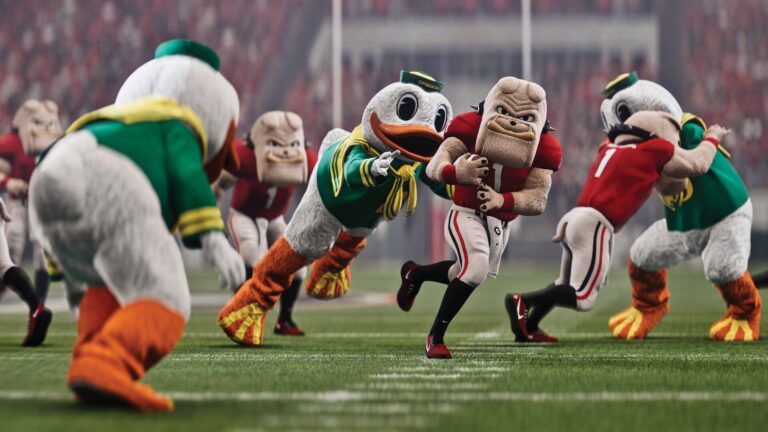
The exception this year is the addition—or rather, the return—of Mascot Mashup, undoubtedly the most famous and asked-about feature from the originals that hadn’t been brought forward to the new era just yet. Just like in its past iterations, Mascot Mashup is effectively just a glorified Quick Play option with the players all swapped out for eleven 99-Overall copies of whichever mascot you choose, performing goofy animations as they come to the line of scrimmage.
While it’s great to get a long-requested mode back, my reaction quickly turned from excitement to a resounding, “That’s it?” Of the 120 mascots included, ten are unlocked from the get-go with the rest locked behind the remarkable challenge of winning one single Play Now game with that team. It’s the same for every mascot. There are no unique challenges, no mascots harder to unlock than others, and no respite from playing dozens of Play Now games to unlock everything—unless you dish out the $150 for the MVP+ subscription that unlocks all mascots.
There are also no announcers for these matchups and no opportunities to play anything other than a straight-up Quick Play game, particularly disappointing given that there was a tournament option all the way back in NCAA Football 14. It’s also baffling that there are no differences in ratings for any of the mascots, especially because the “even teams” option already exists. This could be the ultimate “who would win in a fight” fantasy, yet the Notre Dame Leprechauns are somehow on par with apex predators like Boise State’s Buster Bronco or Western Kentucky’s Big Red.
It’s a nitpick of a casual mode, for sure, but this gives a barebones feeling to what is ostensibly the most notable addition, like it was included out of necessity rather than because it added anything meaningful. There’s tons of opportunity here to create a system for progression, but as it stands, it’s more a novelty that brings back fond memories than something that makes strides forward.
Dynasty: The Real Star of the Show
With Mascot Mashup the only new mode, the adjustments made to existing content are held to higher scrutiny. The biggest changes lie within Dynasty, where the addition of Dynasty Points and the inclusion of new Blueprints make legitimately interesting changes to how you approach and prepare for each season.
Dynasty Points serve as the equivalent of your team’s financial strength, allowing you to hire staff, invest in facilities or program upgrades, and most importantly, fund the NIL deals that heavily influence recruits and transfers. With more success and brand awareness comes more funding, meaning blue bloods like Alabama and Georgia have even more of an immediate leg up than smaller power conference teams or mid-majors—further mirroring the real-life impact that money has had on the college game.
Your Dynasty Blueprint is the structure through which you allocate and spend your Dynasty Points, segmenting them by costs for Staff, Facilities, NIL for Recruits, and NIL for existing players. If you want to focus on Talent Acquisition, you’ll put more points into NIL money, while if you’re focused on player development, you’ll spend more on Staff and Facilities.
Dynasty Points add a significant wrinkle to the experience, complementing recruiting hours as another resource to manage across a longer time horizon. Each player—whether a recruit or already on your roster—has an expectation of how much NIL money they will receive, and offering below that amount significantly impacts their interest, potentially influencing existing players to transfer. Some players are happy to receive any NIL money, but as recruits get better, so do their financial expectations.
At the same time, the game errs on the side of being overly transparent, showing you exactly what a recruit expects and how your offer will influence them. The rest of the menu-heavy recruiting cycle remains nearly identical, though recruits can now verbally commit while still considering their top 3, and you have more control over players’ practice schedules. The only on-field change is the inclusion of Coach Mode, which puts you solely as the playcaller, allowing you to watch from the sidelines as the game simulates based on your calls.
Road to Glory: New Positions, Same Formula
The other significant new content is the addition of three new positions for Road to Glory: Tight End, Edge Rusher, and Free Safety. With eight total positions now, you’re increasingly able to home in on your particular brand of football, playing through your high school journey with specific weekly objectives to impress certain coaches or programs. My primary character was a 3-star Free Safety working to get into one of the big Power 4 schools, ultimately landing at UCF.
Aside from the new positions, much of Road to Glory is the same, for better and worse. It’s still great to see your full rise to stardom through the high school and college process, though it remains weird that a high school tight end or safety is calling plays and that you can game the system, such as an objective to not allow a rushing touchdown being achievable by allowing a long passing touchdown. Quirks aside, Road to Glory gives a great opportunity to play different positions and think through the game differently.
Ultimate Team: Still Predatory
The changes to Ultimate Team and Road to the CFP are less evident, even though the game clearly pushes you to play the cash-grab Ultimate Team first, introducing you with insultingly simple tutorials like “Call a pass play” that get you your first hint of the addictive pack-opening mechanic. With virtually no significant changes, Ultimate Team remains a highly predatory pay-to-win mode that feels built to get you stuck, placing store buttons on every page and requiring you to travel through multiple levels of slow-loading menus.
Gameplay: Incremental Improvements
All the modes serve as pathways to get on the field, and the gameplay maintains the slow positive trajectory that it and Madden have been on for years. While CFB and Madden feel distinctly different—the former emphasizing a faster pace and big plays, the latter calling for more strategic maneuvering—the two experiences quickly coalesce. Improvements to last year’s Madden, such as a more direct impact of weather on players, all make their way here.
The gameplay is undeniably as fun and responsive as it’s ever been, giving you as much control as ever over pre-play and mid-play adjustments. Defensive secondary coverage has significantly more detail this year, providing not just the ability to press or back off, but also to adjust individual depth, shift zone placements, or give universal instructions to be more or less aggressive to the ball. I also appreciate the tweaks to give you more control over how your secondary responds when a play breaks down and the ability to more easily change coverage assignments on the fly.
However, the increased micro-control over every aspect of your team exemplifies the asymptotic rise to complete football realism without adding much to the experience itself. As much as I appreciate being able to shift my slot corner’s positioning down to the foot, I struggle to believe that so many small adjustments provide enough new material to warrant a full-price release.
Verdict
With EA now putting out two football games a year and synchronizing many gameplay tweaks across both, there is even less reason to upgrade on a year-to-year basis, especially if you’re an annual player of either or both games. CFB 27 feels like another point on a consistent but slow-moving line graph rather than an exciting or refreshing new entry.
Like a 3-yard run on 2nd & 9, EA Sports College Football 27 makes some moves in the right direction but fails to create something more impactful. The on-field gameplay continues to add micro-improvements, and it looks and feels as strong as it ever has. But with those minor upgrades comes an expectation of materially new content, which CFB 27 largely lacks. Mascot Mashup feels hastily made, Dynasty and Road to Glory have some changes but the overall experience feels glacially slow, putting out annual entries that technically improve but hardly warrant a new release.
While annual fans and football junkies like me will appreciate some nuanced tweaks, CFB 27 needs more than just marginal improvements to make a real statement.
Related posts:
 F1 25: 2026 Season Pack Review – Evolution Over Revolution, But Worth the Upgrade
 Myst Remake PS5 Review – Light Reading, Heavy Thinking
 Gothic 1 Remake Review – Flaws and All, a Brutal Return to the Colony
 Yoshi and the Mysterious Book Review – Delightful, Dazzling, and Surprisingly Deep
 #DRIVE Rally PS5 Review – Racing to Forget, but Hard to Remember
 Final Fantasy 7 Rebirth Nintendo Switch 2 Review – The (Portable) Promise Fulfilled
 The Alters: Last Variable Review – The Science of Self-Discovery
 Brokenlore: FOLLOW Review – Growing Up Too Fast, Haunted Forever