
The Yoshi series has had an interesting trajectory since the world-conquering classic Yoshi’s Island. It received multiple follow-ups across N64, DS, and 3DS, but all of them variously failed to match the heights of the Super Nintendo original. Woolly World on Wii U, however, was an excellent game—the best the series had been in decades—and portended a brighter future. Those hopes were dashed when the crafts-inspired Yoshi’s Crafted World released on Switch in 2019 and… wasn’t particularly good.
Which brings us to Yoshi and the Mysterious Book. This new entry has a clear vision that it executes nearly flawlessly—a vision that also informs and justifies the design choices it makes.
A Visual Feast
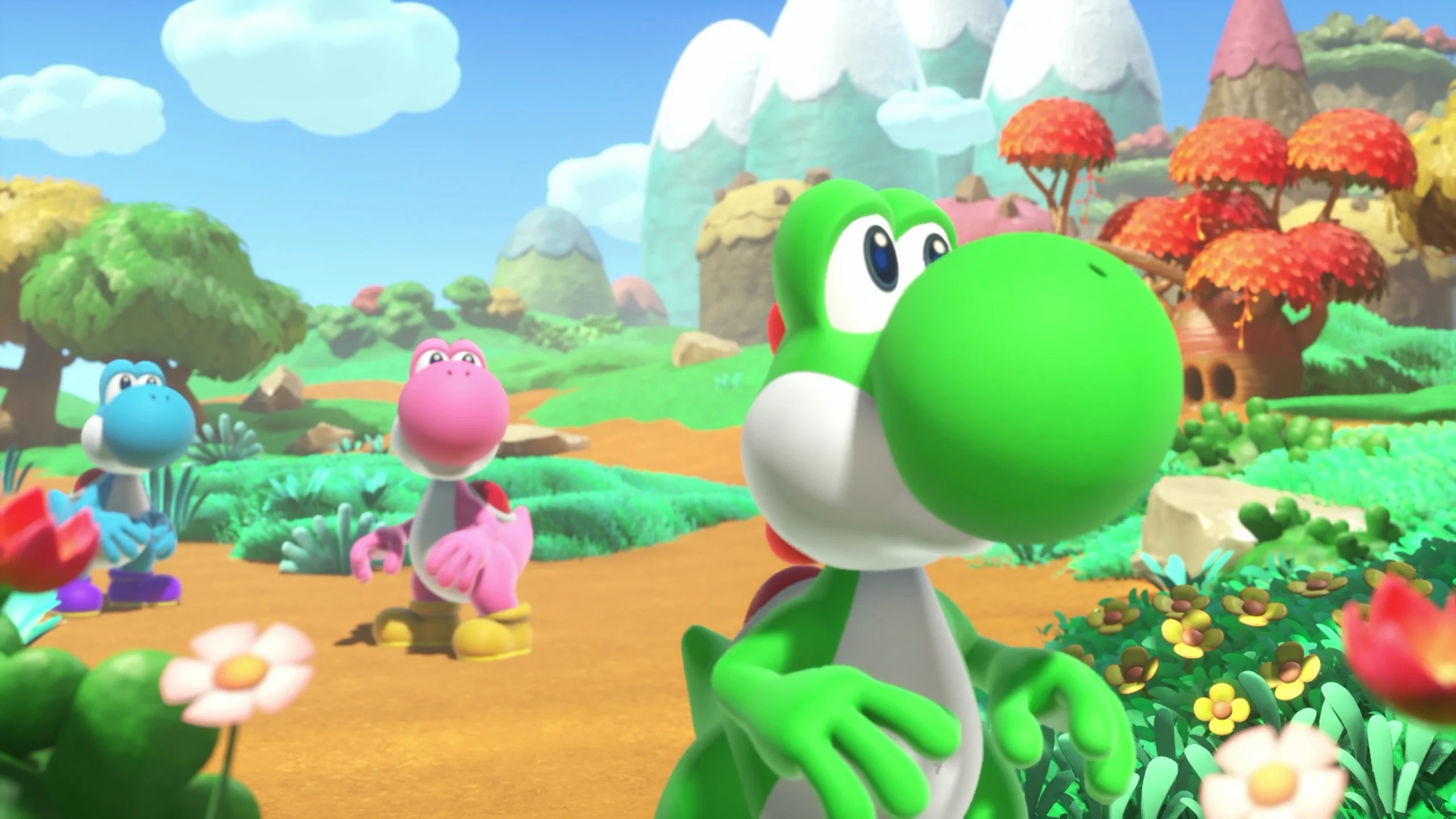
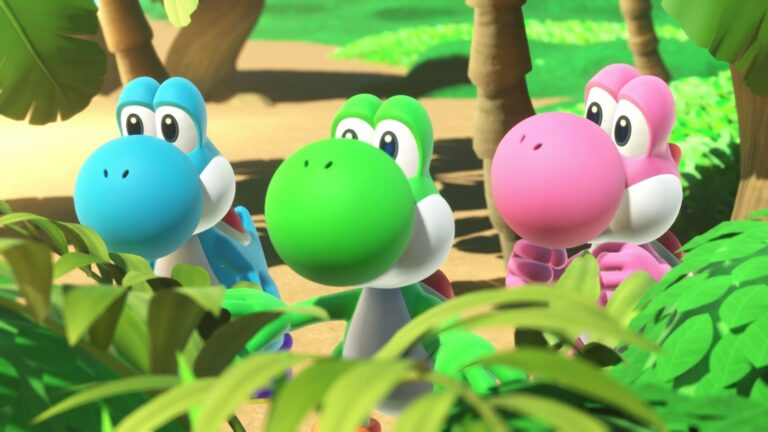
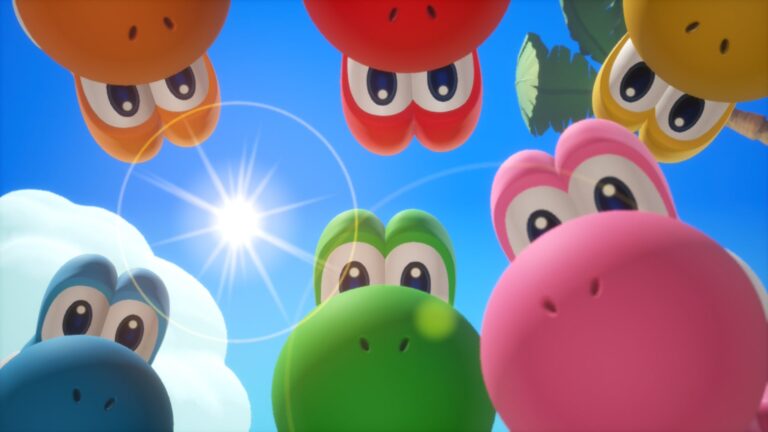
There are two specific qualities that have persisted through every Yoshi game: they are exceptionally easy, almost aimed at beginners and younger players; and they are almost always absolutely gorgeous, imbuing art and aesthetics that emphasize stylized animation and expressiveness over photorealism. Both hold true for Mysterious Book.
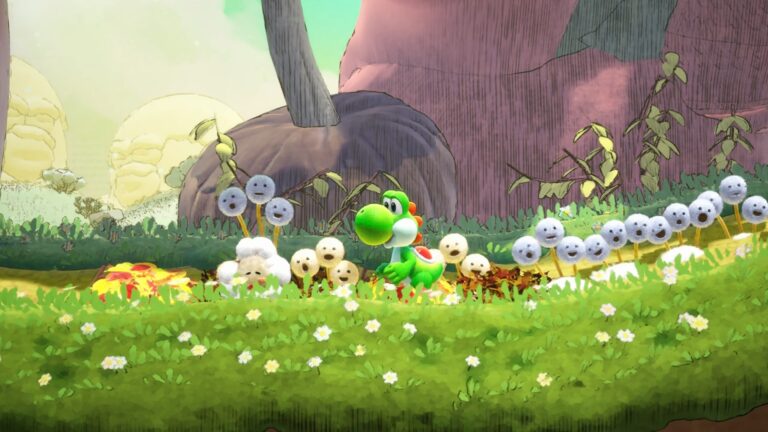
Let’s talk about that latter point first, because it’s—expectedly—the thing that stands out immediately. Eschewing the crafts-inspired look of the last couple of Yoshi games, Mysterious Book instead returns to the storybook-inspired fairy tale aesthetic that Yoshi’s Story sort of hinted at. I say “sort of,” because Mysterious Book is a more full-fledged realization of that style than anyone may have expected—to a startling degree.
Multiple animations and transitions in the game have flourishes inspired by that conceit, from text and prompts showing up as doodles on the book’s page, to levels slowly being drawn in when you enter them for the first time. Animations in particular stand out, with their distinct stop-motion style drawing attention immediately and emphasizing them that much more.
A Technical Marvel on Switch 2
Mysterious Book is one of the increasing number of Nintendo games built in Unreal Engine—in this case, Unreal Engine 5. Normally, this can mean a poorly optimized experience, particularly on hardware with lower power and resources like the Nintendo Switch 2. It is astonishing, then—and presumably a testament to Nintendo and developer Good-Feel’s mastery of the engine and hardware—that none of that holds true here.
There’s no stutter, no overhead, and the image quality is great—at least in docked mode, where, no matter how big the TV screen I played it on, Mysterious Book looked gorgeous. In handheld mode, I did find the image slightly softer by comparison. It still remained a good-looking game, but the image quality in handheld mode was closer to what I had expected the game to have throughout. It’s a win that docked mode looks as good as it does, though it’s a shame that doesn’t extend to handheld play.
A New Kind of Challenge
As I mentioned earlier, Yoshi games are remarkably easy—to the point that one might consider them suitable for being the very first games someone plays. In the past, this lacking difficulty hasn’t necessarily been justified by the game’s larger design goals. The games, nonetheless, remained extremely easy side-scrolling platformers, lacking challenge to the point that it was reasonable to ask what the appeal was for anyone who didn’t fall into the “very young” or “starting out” buckets.
Mysterious Book answers that question—and it answers it delightfully well. The game remains a 2D platformer, as before, but it completely gives up combat, hazards, and fail states. Instead, it’s a puzzle platformer, where the point of each level is traversing the environment by leveraging interactions and combinations.
Each level is based around one creature (flora or fauna), and as you play, you learn more about it. You might learn that jumping on it lets you gain more height. Or that it will absorb water, clearing paths for you. Or that it can make flowers bloom. Or that it plays a musical note when struck. Every level is based around one of these creatures, and each has a seemingly endless and dizzying array of interactions—with Yoshi, with similar creatures, with its prey or predators, with its environment, and more. After a while, the game almost becomes a toy box, where the challenge, more than anything the game poses to you, is figuring out if a certain interaction you have in mind can actually be made to play out.
In this way, Yoshi and the Mysterious Book exemplifies the toy box design philosophy that Nintendo has embraced since the dawn of the Switch era with Breath of the Wild. Practically everything in the game interacts with everything else, often in unexpected and delightful ways. Those interactions stack and cascade, and they almost never fail to elicit a smile.
Accessibility at Its Finest
The remarkable thing here is that this premise lends itself remarkably well to the low-difficulty conceit of the Yoshi series. You are merely observing these creatures inside the book’s pages, discovering and recording their interactions. There’s no possible scope for you to die—enemies can’t kill you, fall damage can’t kill you, and bottomless pits can’t kill you.
Where something damages you, you’re returned instantly to the last safe spot with no penalty or loss whatsoever. There’s also no time limit or any other pressure on you. Instead, you can take your own time—however long or short—in figuring out all the ins and outs of the level you’re in.
This makes the game remarkably well-suited to younger audiences. The 2D plane view means it’s extremely easy to control, with no camera or 3D movement to contend with. The lack of time limits, enemies, hazards, combat, or even a lives system means you have as much slack as you need when going through levels—and if you need even more, you can press the L button at any time to pull up a hint about what you should be doing.
Kids don’t have to worry about coordination or reflexes. They don’t need to worry about “winning” or even “progressing.” Realistically, they can spend as much time as they want in a single level, exhausting its bevy of interactions to their heart’s content, and move on when they’re done.
Verdict: A Delightful Surprise
Where the lack of difficulty presented a problem in the more straightforward 2D platformer format that past Yoshi games adopted, here it hardly matters—because the point, the challenge, is discovering various interactions and using them to get what you want. It’s impressive that a game this easy feels this engaging and compelling, simply by reframing its conceit away from challenge and progress to play and exploration.
Yoshi and the Mysterious Book isn’t necessarily a killer app, or the next great Nintendo game for those waiting on that. It is, however, a game of the type that only Nintendo makes anymore—certainly with this level of budget and polish. I expected to appreciate its merits from a distance, understanding that the game was well-suited to its intended audience, but finding little for myself within it.
Instead, I found myself delighted by its whimsical depth and its never-ending trove of surprises. I would love to see a potential future Yoshi game iterate on this formula and improve upon it even further.
Related posts:
 Brokenlore: FOLLOW Review – Growing Up Too Fast, Haunted Forever
 Final Fantasy 7 Rebirth Xbox Series X Review – Expected Excellence, Delivered in Full
 The Mound: Omen of Cthulhu Review – Welcome to the Jungle, Where Nothing Quite Works as Intended
 Dead or Alive 6 Last Round Review – One Fight at a Time, But Maybe Not Online
 Final Fantasy 7 Rebirth Nintendo Switch 2 Review – The (Portable) Promise Fulfilled
 DOOM: The Dark Ages – Revelations Review – Only You Can Rip and Tear This Well
 Riven Remake PS5 Review – To the Rescue, but Not Without Its Wrinkles
 Gothic 1 Remake Review – Flaws and All, a Brutal Return to the Colony